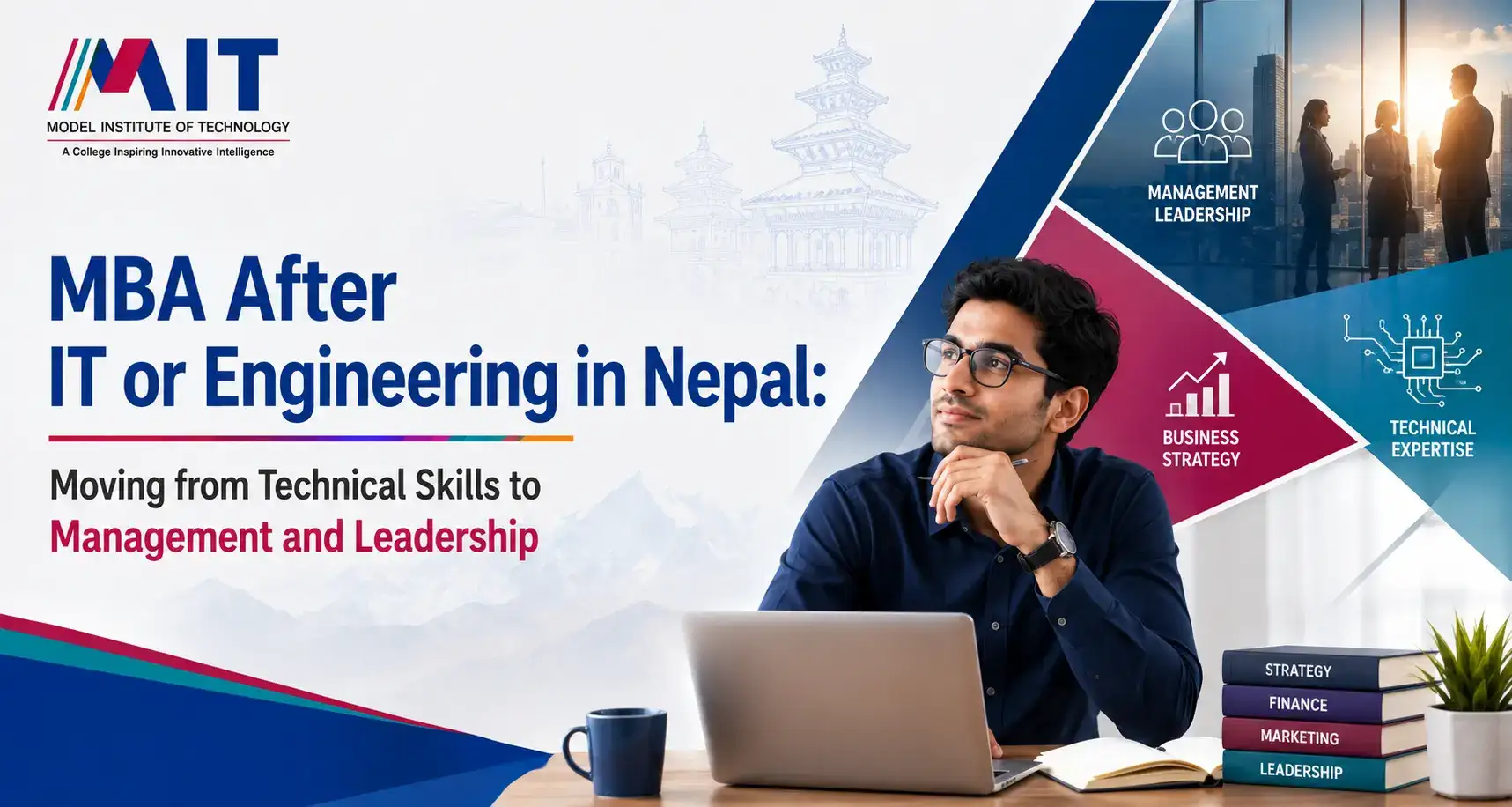
MBA After IT or Engineering in Nepal: Career Transition from Technology to Management
September, 18, 2026
MIT Nepal
IT and engineering graduates often begin their careers by solving technical problems. A developer may build applications, a BIT graduate may work with information systems, and an engineer may focus on design, infrastructure, production, or technical operations. As experience grows, however, many professionals become interested in the decisions surrounding that work: budgets, customers, teams, business priorities, product direction, and long-term strategy.
An MBA after IT in Nepal can support this shift by adding business and management knowledge to an existing technical foundation. It does not replace a technical degree. Instead, it can help graduates understand how technology, finance, people, operations, and business strategy work together inside an organization.
For graduates who want to move toward product management, technology leadership, consulting, analytics, project management, entrepreneurship, or business strategy, this combination can open broader career paths without requiring them to abandon their technical expertise.
Can Technical Graduates Apply for an MBA in Nepal?
Yes, technical graduates can move into an MBA without having a previous business degree, as long as they meet the university’s admission requirements.
Graduates in IT, BIT, engineering, computer science and other technical disciplines can apply for an MBA.
At MIT Nepal, applicants must have completed a bachelor's degree or an equivalent qualification from a recognised university.
A prior degree in business or management is not required.
MIT's current admission FAQ states that there is no entrance examination for admission.
Applications are assessed based on factors such as academic background, learning attitude and personal qualities.
Applicants are currently asked to submit:
Passport-size photographs
A copy of citizenship or passport
Academic transcripts, certificates and character certificate from the highest qualification earned
IELTS, TOEFL or PTE results, or confirmation that previous study was completed in English medium
What Changes When You Move From a Technical Degree to an MBA?
The main change is that you begin looking beyond how something works and start considering why it matters to the business and how it should be managed.
Technical focus: solving problems related to systems, applications, engineering processes or infrastructure.
Business focus:evaluating whether an idea is financially viable, commercially useful and aligned with organisational goals.
Accounting and finance: understanding costs, budgets, profitability and financial impact.
Marketing: learning about customers, competition, positioning and market demand.
Organisational behaviour and HR: understanding teams, leadership, motivation and people management.
Business strategy: deciding which opportunities an organisation should pursue and how resources should be allocated.
Operations management: improving processes, efficiency and delivery.
Entrepreneurship: learning how to turn a technical idea into a workable business.
For technical graduates, the shift is from simply asking “Can we build it?” to also asking “Should we build it, who needs it and how can it create business value?”
Business Knowledge That Complements a Technical Background
For IT or engineering graduates, MBA subjects introduce business and management areas that may be new compared with their technical studies. Key areas include:
Accounting and finance: understanding costs, budgets, financial performance and investment decisions
Marketing: understanding customers, competition, value propositions and market demand
Economics: examining how pricing, demand and wider market conditions affect organisations
Organisational behaviour: understanding motivation, teams and workplace behaviour
Human resource management: managing people, performance and organisational capability
Strategy: deciding where an organisation should compete and how resources should be used
Operations: improving processes, resources and delivery
Business communication: presenting recommendations to managers, clients and stakeholders
Entrepreneurship: connecting an idea with customers, finance, operations and a sustainable business model
These subjects add a commercial perspective to technical expertise. A developer, for example, may understand how an application functions while an MBA can help them think about pricing, customer acquisition, operational costs and business value.
Technical Strengths That Carry Into Management
Technical graduates already bring valuable management skills, including analytical thinking, problem-solving, data interpretation and logical decision-making. Their ability to break down complex problems, evaluate evidence and compare solutions can transfer naturally from technical work to business decisions.
Other transferable strengths include:
Project discipline from working with deadlines, scope and dependencies
Data literacy for interpreting evidence before making decisions
Research ability for comparing options and testing assumptions
Digital-system knowledge when evaluating technology investments
Process thinking when improving operations and workflows
Technical communication when explaining complex topics to non-technical stakeholders
These capabilities can become especially valuable when a manager needs to communicate with both technical specialists and senior business decision-makers.
Why MIS Creates a Strong Link Between Technology and Business
Management Information Systems, or MIS, sits directly between technology and organisational decision-making. It examines how businesses use information, digital systems and technology to improve processes, support managers and achieve organisational objectives.
For someone considering an MBA after BIT in Nepal or an MBA after engineering in Nepal, this creates a natural connection with their previous education. Instead of focusing only on how a system is built, MIS considers how that system supports operations, employees, customers and management decisions.
A professional working between technology and business may need to understand why developers raise technical constraints while also recognising why senior management is concerned about cost, timelines or customer outcomes. Being able to interpret both perspectives can make technical graduates particularly useful in cross-functional roles.
Business Analytics and Data-Driven Decision-Making
Technical graduates are often comfortable working with numbers, data structures and analytical tools. Business analytics adds another layer by asking what the data means for an organisation and what action should follow from it.
A report showing declining customer engagement, for example, is only the beginning. A business-oriented analyst must investigate possible causes, assess the commercial impact and recommend an appropriate response. The value comes from connecting data with business decisions.
This is why analytics can be a practical direction for technical graduates. Their existing quantitative abilities can support the analysis, while MBA knowledge helps them interpret findings through finance, marketing, operations and strategy.
Product and Technology Management Career Paths
Product and technology management are strong examples of careers where technical and business knowledge overlap. A product manager may need to understand developers and technical constraints while also considering customer needs, market demand, costs and organisational objectives.
An MBA for IT professionals can therefore be relevant to people who no longer want their responsibilities limited to technical execution. Possible career directions include product management, technology management, IT management, digital transformation and technical program management.
These roles often require someone who can understand the technology without losing sight of the business reason behind it. That combination can be particularly valuable in organisations where digital products or technology systems are central to operations.
Consulting and Business Improvement
Consulting can also appeal to technical graduates because it rewards structured problem-solving. Business and technology consultants study organisational problems, identify weaknesses and recommend changes.
An engineer may bring process knowledge, while an IT graduate may understand systems, databases or digital workflows. An MBA can add the financial, strategic and organisational perspective needed to evaluate the wider business impact of those issues.
Relevant areas may include technology consulting, process improvement, digital transformation and business consulting. Success in these roles depends not only on analytical ability but also on communication, stakeholder management and the ability to explain recommendations clearly.
Operations, Projects and Process Management
Engineering and IT graduates often have experience working within structured projects. They understand deadlines, testing, resources, dependencies and the consequences of delays. These skills can transfer naturally into operations and project-management environments.
Management education adds knowledge of budgets, organisational behaviour, leadership and business priorities. A project is no longer viewed only as a technical deliverable; it becomes part of a wider organisational goal.
Graduates looking at management courses after engineering may find operations, project management and process optimisation especially relevant because they allow existing technical thinking to remain useful while expanding responsibility.
Entrepreneurship for Technical Graduates
Technical professionals frequently have the ability to build products or identify practical problems worth solving. What they may lack is experience with customers, pricing, financial planning, market positioning or team management.
An MBA can help connect the technical idea with these business considerations. This can be valuable for developers, engineers or BIT graduates who want to create technology startups, digital services or other businesses built around their professional expertise.
A technically impressive product still needs customers, a viable operating model and a growth plan. Entrepreneurship requires both the ability to create something and the ability to build an organisation around it.
Developing Leadership Beyond Technical Expertise
Moving into management changes how professional performance is measured. A specialist may be judged mainly by the quality of their own work, while a manager becomes responsible for the performance of teams, projects, budgets and wider organisational decisions.
An MBA can help technical graduates strengthen areas such as leadership, negotiation, strategic thinking, communication, team management and financial awareness. These skills become increasingly important as responsibilities move beyond individual technical tasks.
The objective is not to stop being technical. A stronger progression can be to understand the technical side while also being capable of explaining its business implications, coordinating teams and making decisions that support organisational goals.
How MIT's MBA Connects With Technical Graduates
The MBA program at MIT Nepal is currently listed as a two-year, 60-credit graduate program. Its published curriculum includes core business courses covering accounting, law, economics, finance, organisational behaviour and leadership, human resources, marketing and Management Information Systems.
The presence of Management Information Systems as a core course is particularly relevant to students coming from IT, BIT and engineering because it connects technology with managerial decision-making. Students still study broader business functions, allowing them to understand how technology decisions affect finance, people, customers and operations.
The core courses currently listed include:
Accounting for Managers
Business Law for Managers
Managerial Economics
Financial Management
Organisational Behaviour & Leadership
Human Resource Management
Management Information Systems
Marketing Management
MIS Electives for Students Interested in Technology Management
MIT's published MBA curriculum includes an MIS elective group with subjects that have a direct connection to technology and business management. These currently include Business Analytics and Data Processing, Enterprise Resource Planning for Managers, Database Management Systems and IT Project Management.
These subjects may be especially relevant to students who want a hybrid career rather than moving completely away from technology. Someone with an IT background could use their existing technical knowledge while developing the ability to evaluate systems from a management perspective.
It is important to understand that these are elective groups within the MBA program rather than separately awarded MBA degrees or majors. Students should review the latest curriculum before selecting subjects because elective availability can depend on the academic structure of the program.
Practical Learning and Career Preparation at MIT
The MBA curriculum includes an internship component and a final MBA Capstone: Strategy & Competition. MIT's published graduation information also refers to participation in a minimum of two internship experiences.
The MBA course information further lists co-curricular activities such as business case competitions, business conferences, entrepreneurship pitch competitions, leadership workshops, leadership and management training, networking events and industry visits. These activities can help students apply management concepts outside traditional classroom study.
MIT's Student Affairs information also describes support that includes counselling, internship and job-placement assistance, industry linkages and exposure tours. Students who want to explore the program can review the MIT Nepal website and submit an MBA application to confirm current intake information.
Technical Career vs Management Career vs Hybrid Career
The right postgraduate route depends on the type of work you want to do next. An MBA is not automatically better than a technical master's degree, and a technical master's degree is not automatically better than an MBA.
Career Direction
Main Focus
Suitable Career Goals
Technical specialisation
Deeper technical expertise
Software engineering, cybersecurity, AI, engineering design, systems or research
Management-focused route
Business, leadership and strategy
Consulting, operations, management, entrepreneurship or organisational leadership
Hybrid technology + management route
Combining technical and commercial understanding
Product management, IT management, analytics, digital transformation or technology consulting
A specialised technical master's degree may be the better choice when the goal is advanced technical expertise. An MBA may be more relevant when the goal is to manage products, projects, teams, organisations or commercial decisions.
Questions to Ask Before Choosing an MBA
An MBA can make sense when your career interests are beginning to move beyond purely technical execution. The decision should be based on the responsibilities you want in the future rather than the assumption that every technical graduate needs a management degree.
Consider the MBA route when:
You enjoy business strategy and decision-making
You want to manage teams, products or projects
You want to understand finance and marketing
You are interested in consulting or digital transformation
You want to work between business and technology teams
You plan to start or manage a business
You want greater responsibility for organisational decisions
A specialist technical program may suit you better if your strongest interest remains deep software development, engineering research, cybersecurity, AI or another area where advanced technical depth matters more than management responsibility.
Take the Next Step Toward Technology and Business Leadership
An MBA after IT in Nepal can help you build on your technical background while developing the business, management and leadership skills needed for broader career responsibilities.
If you want to explore whether an MBA aligns with your career goals, review the program details and get in touch with the admissions team for current information on eligibility, curriculum and applications.
Build on your technical expertise and prepare for broader management and leadership opportunities.
FAQs
Can BIT graduates apply directly for an MBA?
Yes, BIT graduates can apply for an MBA if they meet the university's admission requirements.
Do IT graduates need a business degree before starting an MBA?
No, IT graduates do not need a previous business degree to pursue an MBA.
Are engineering graduates suitable for management studies?
Yes, Engineering graduates already develop analytical thinking, problem-solving and project discipline that can transfer well into management.
Which jobs combine an IT background with an MBA?
Common options include product management, IT management, business analysis, consulting, project management and digital transformation.
Should a software professional choose an MBA or a technical master's?
Choose an MBA for management and leadership. Choose a technical master's for deeper technical specialisation.
Can someone move from software development into management?
Yes, software professionals can move into product, project, technology or team-management roles with the right business and leadership skills.
Does an MBA guarantee a managerial role?
No, an MBA supports career development but does not guarantee a management position, promotion or salary increase.
What makes technical graduates valuable in business roles?
They combine technical knowledge, analytical thinking and business understanding, helping connect technology with organisational goals.