Why Study BIT at MIT Nepal? Recognition, Eligibility and Career Scope
August, 1, 2026
MIT Nepal
Choosing a Bachelor of Information Technology is not only about finding a college that teaches programming. Students also need academic structure, space to explore different areas of technology, and practical guidance as they develop their career direction.
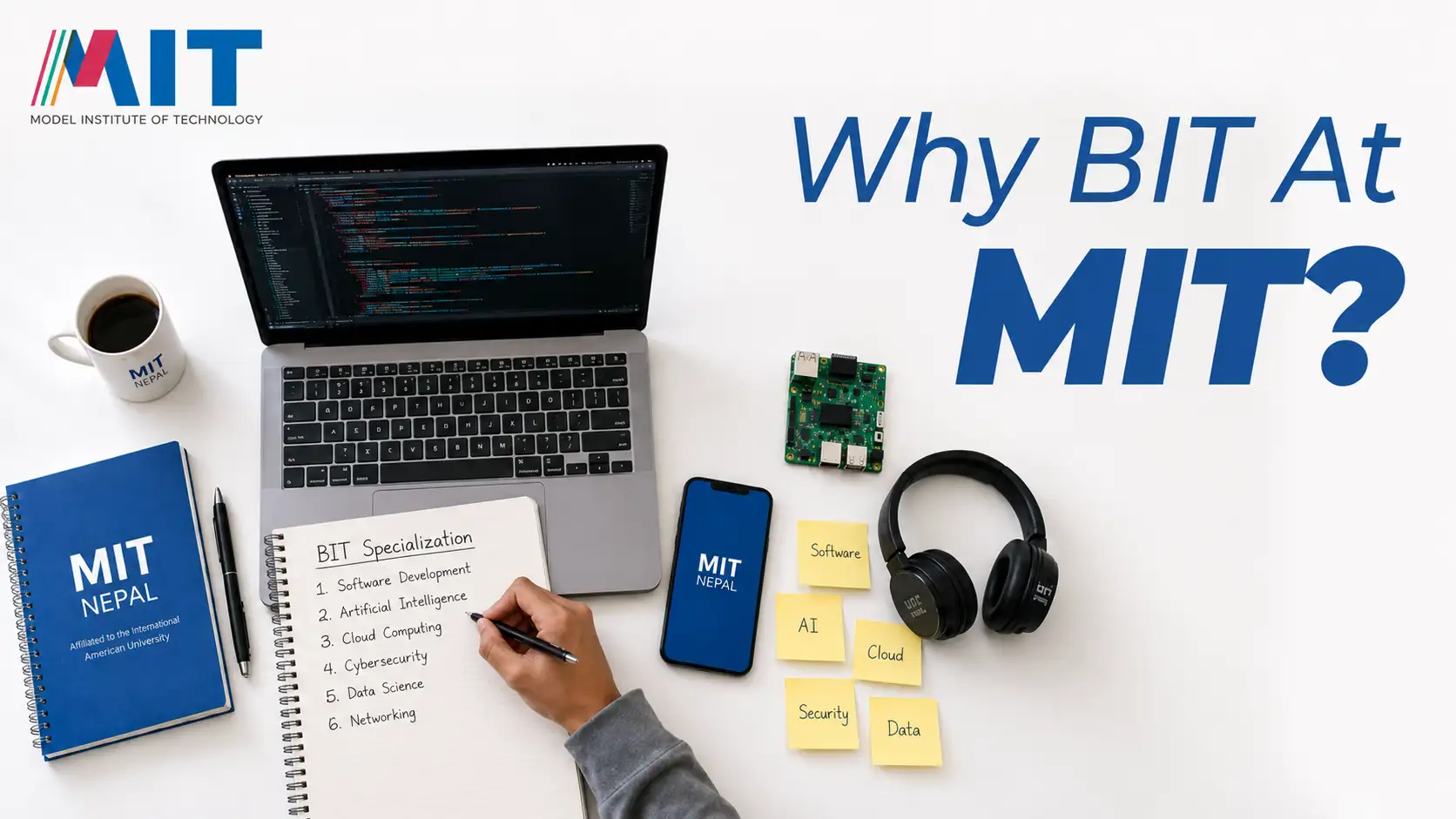
The BIT program at MIT Nepal is a four-year, 120-credit undergraduate degree offered in affiliation with International American University in the United States. It combines programming, data, networking, cybersecurity, cloud computing, artificial intelligence, communication, electives, internships, and capstone work.
At the center of this experience is MIT’s philosophy of Freedom with Direction. Students receive room to explore their interests, but that freedom is supported by a structured curriculum, academic guidance and opportunities to connect learning with the professional world.
Why Choose BIT at MIT Nepal?
BIT at MIT combines an American university-affiliated curriculum with structured academic guidance and practical learning opportunities in Nepal. Its broad curriculum helps students build a strong IT foundation while exploring career paths across software, data, networking, cybersecurity, cloud computing, and artificial intelligence.
Students can expect:
A four-year, 120-credit BIT degree
Affiliation with International American University
A curriculum covering core and emerging areas of IT
Elective opportunities for broader exploration
Internship and capstone requirements
Career support and links with industry partners
Co-curricular activities such as hackathons, workshops and tech meetups
Scope across software, data, security, networks, cloud and technology management
The program is suitable for students who want a broad understanding of information technology before deciding which area they want to pursue more deeply.
What Does Freedom with Direction Mean at MIT?
Freedom with Direction means giving students choices while ensuring that those choices contribute to meaningful academic and professional development.
Technology is a wide field. A student may begin BIT wanting to become a software developer but later discover an interest in cybersecurity, data analytics, cloud computing or IT project management. Another student may enjoy technology but prefer consulting, fintech or digital business over a purely programming-focused role.
MIT’s philosophy recognizes that students need time and exposure before making such decisions.
Freedom
Direction
Exploring different areas of IT
Following a structured academic foundation
Choosing suitable electives
Receiving guidance on academic and career choices
Developing personal project ideas
Applying technical principles and project standards
Participating in clubs and competitions
Building skills relevant to professional environments
Considering different career paths
Using internships and capstone work to test those interests
Freedom with Direction gives students room to explore their interests while maintaining academic discipline. It helps them understand their strengths, address skill gaps, and make informed career decisions without directing everyone towards the same path.
How Does the BIT Curriculum Provide Both Structure and Choice?
The required professional component gives students a broad foundation across several connected areas of information technology:
Programming and software development: Fundamentals of Programming, Object Oriented Programming with Java, Data Structures and Algorithms, Software Engineering, and Web Design and Development
Computer systems and networking: Computer Organization and Architecture, Operating Systems, Computer Networking, and Network and System Administration
Data and emerging technologies: Database Management Systems, Data Warehousing and Data Mining, and Artificial Intelligence
Security and cloud: Cybersecurity, Cloud Computing and Virtualization
Logic and project planning: Discrete Structures and Software Project Management
This breadth helps students understand how different areas of technology work together, making BIT broader than a coding or software development degree. Students can also explore what they will learn during BIT.
Communication and General Education
Technical skills are important, but professional success also depends on effective communication, critical thinking, teamwork and decision-making. The core curriculum develops supporting skills across several areas:
Communication: Academic Writing, Public Speaking and Critical Thinking
Mathematics and analysis: Business Mathematics, College Algebra and Statistics
Social and economic understanding: Psychology, Sociology and Microeconomics
These subjects help students write reports, present ideas, conduct research, collaborate in teams and communicate with both technical and non-technical audiences.
Elective Opportunities
The elective component allows students to earn credit from eligible undergraduate courses outside the compulsory requirements. Electives can support:
Academic exploration: Explore subjects before choosing a career direction
Broader knowledge: Connect technology with business and other disciplines
Personal development: Strengthen weaker areas and build supporting career skills
Available electives may vary by term, faculty and delivery schedule. Students should request the latest elective list for their intake.
Internships and Capstone Work
The curriculum includes internships and capstone work to help students apply academic knowledge in practical settings. Students must participate in at least two internship experiences, which can introduce them to professional teamwork, project planning, documentation, workplace responsibilities and employer expectations.
The final capstone brings knowledge from different subjects together in a substantial technical project or problem. Students should confirm the current project format, supervision process and assessment requirements with the department.
Is the BIT Degree at MIT Recognized?
MIT offers the BIT program in affiliation with International American University, which is the degree-awarding university.
Recognition should be understood through three separate areas: university accreditation, approval to operate in Nepal, and acceptance by the organization where a graduate later applies.
International American University Accreditation
International American University is institutionally accredited by the Transnational Association of Christian Colleges and Schools. Its accreditation was reaffirmed in April 2025 and is effective from July 2025 through June 2035.
TRACS is recognized by the United States Department of Education and the Council for Higher Education Accreditation. Applicants can verify the current status through the official IAU accreditation page.
Approval in Nepal
MIT Nepal is approved by Nepal’s Ministry of Education, Science and Technology to deliver its academic programs in Kathmandu. Accreditation applies to International American University as the degree-awarding university, while approval concerns MIT Nepal’s authority to deliver the programs in Nepal.
What Does Recognition Mean for Students?
Recognition provides an important academic foundation, but it should not be presented as automatic acceptance by every employer, university or government authority.
Acceptance may depend on:
The policies of the receiving university
Employer requirements
Professional licensing rules
Country-specific degree evaluation procedures
Transcript and credit requirements
The purpose for which the qualification is being evaluated
Students planning to pursue a postgraduate degree, transfer credits or use the qualification in a particular country should verify the requirements of that institution or authority in advance.
Who Is Eligible to Study BIT at MIT?
Applicants who have completed Grade 10+2 or an equivalent qualification may apply, regardless of their academic stream.
Minimum Grade Requirement
MIT’s BIT page shows a small difference between its formal admission criteria and FAQ. The formal criteria require completion of Grade 10+2 or an equivalent qualification but do not specify a minimum grade.
The FAQ states that applicants typically need at least a 2.0 CGPA or 45 percent aggregate marks and notes that requirements may vary. Applicants should therefore confirm the current threshold before applying.
Do Applicants Need Previous Coding Experience?
Previous programming or Computer Science study is not listed as an admission requirement.
Students can enter with different levels of preparation:
Science students may be more familiar with mathematics and logical problem-solving.
Management students may bring knowledge of business, accounting or computer applications.
Humanities students may have strengths in communication, research and creative thinking.
Students without Computer Science may need more initial practice with programming and digital tools.
Your previous academic stream may affect the areas in which you need additional preparation, but it does not determine your ability to succeed in BIT. Contact MIT Nepal to confirm the latest eligibility criteria, required documents, and admission process.
How Do Industry Partnerships Support BIT Students?
MIT supports practical exposure through internships, placement assistance, guest lectures, field visits, workshops, hackathons, seminars, and tech meetups. These opportunities may help students:
Gain workplace exposure: Observe professional practices and understand current tools and industry expectations
Develop practical skills: Work on real problems and learn directly from IT professionals
Build career readiness: Improve communication, prepare CVs and practice interviews
Explore opportunities: Develop professional contacts and learn about internships and entry-level roles
What Should Applicants Ask About Industry Partnerships?
Industry partners and internship arrangements can change. MIT’s public pages do not currently provide a complete, updated list of named BIT partners or guarantee a specific placement for every student.
Before enrolling, ask:
Which organizations currently work with BIT students?
What types of internship roles were offered recently?
Are internships assigned or competitively selected?
When do students normally begin internships?
Are internships paid or unpaid?
What preparation is provided before interviews?
Which technical skills do partner organizations expect?
What recent projects have students completed with industry involvement?
These questions provide more useful information than relying only on the number of partnership logos shown in promotional materials.
What Co-Curricular Opportunities Are Available?
MIT offers co-curricular activities that extend technical learning beyond regular classes. Opportunities may include:
Technical activities: Hackathons, competitions, data camps and certification programs
Professional learning: Workshops, seminars, tech meetups and student conferences
Community and career exposure: Technology clubs, volunteering, community workshops, internships and placement fairs
These activities can strengthen technical confidence, teamwork and networking when students participate actively. Choosing opportunities that support a career goal, such as a coding competition for software development or a data camp for analytics, can also help build a more relevant portfolio.
What Is the Career Scope After BIT at MIT?
BIT can lead towards several technical and technology-supported career areas, but the degree alone does not guarantee a particular job.
The published career prospects include:
Software and Application Development
Students interested in building digital products may explore roles such as:
Junior software developer
Web developer
Mobile application developer
Software testing or quality assurance assistant
Application support associate
Data and Database Careers
Students who enjoy organising, analysing and interpreting information may consider:
Junior data analyst
Database support associate
Business intelligence assistant
Data operations associate
Entry-level database administrator
Cybersecurity and Networking
Students interested in infrastructure and digital security may explore:
Network support technician
Junior system administrator
Security operations trainee
Cybersecurity support associate
IT infrastructure assistant
Cybersecurity and networking continue to evolve as organizations respond to emerging threats, changing technologies and growing infrastructure needs. Explore the key developments in cybersecurity challenges and trends.
Cloud and Systems
Cloud technology supports modern applications, storage and business operations. Possible directions include:
Cloud support associate
Systems support technician
Infrastructure operations assistant
Junior DevOps trainee
Technical support engineer
Artificial Intelligence and Emerging Technology
The curriculum introduces Artificial Intelligence and includes foundations in programming, statistics and data.
Possible long-term directions include:
AI or machine learning trainee
Data preparation associate
Automation support
AI application testing
Research or project assistance
Entry-level AI roles usually require additional projects, mathematics, and specialized learning beyond one introductory course. Students should treat the BIT curriculum as a foundation rather than a complete AI specialization.
Technology Management and Consulting
Students who combine technical understanding with communication and organizational skills may consider:
IT project coordinator
Systems analyst trainee
Technology consultant
Business technology associate
Product support associate
Digital marketing technology specialist
Fintech operations associate
Students can review this guide to IT careers after BIT when comparing possible career directions.
What Determines Your Career Progress After BIT?
Career progress depends on how effectively students turn their academic learning into practical evidence of ability. Employers may consider:
Technical ability: Subject knowledge, problem-solving skills and relevant certifications
Practical experience: Academic projects, personal projects and internship performance
Professional skills: Communication, teamwork and workplace behavior
Career readiness: Portfolio quality and continued learning after graduation
Freedom with Direction applies here as well. Students can choose their interests, but they need a clear plan to develop relevant skills, gain experience and demonstrate what they can do.
Is BIT at MIT the Right Choice for You?
The right BIT program should match how you want to learn and where you hope to take your career. MIT’s BIT is designed for students who value academic flexibility, practical exposure and guidance while exploring different areas of technology.
It may be a suitable fit if you:
Want to study programming, data, networking, cloud computing and cybersecurity
Prefer exploring different IT fields before specializing
Value projects, internships and co-curricular learning
Want to develop both technical and communication skills
Are prepared to practice regularly and use available opportunities actively
Before deciding, compare the current curriculum, teaching approach, electives, internships, fees and recognition requirements with your academic and career goals.
Begin Your BIT Journey with Clarity
Choosing BIT should involve more than asking whether the degree has good scope. The better question is whether the curriculum, learning philosophy and available opportunities match the kind of student and technology professional you want to become.
MIT’s Freedom with Direction philosophy gives students room to explore while maintaining a structured foundation through professional courses, electives, internships, practical activities and capstone work.
Review the current BIT curriculum at MIT, confirm the latest intake requirements and ask specific questions about electives, industry partners and internship arrangements. Once you are satisfied that the program fits your goals, you can apply for BIT online.
FAQs
Is MIT’s BIT an American degree?
Yes. MIT offers the BIT program in affiliation with International American University in the United States.
What does Freedom with Direction mean at MIT?
It means students can explore different subjects, projects and career interests while following a structured curriculum and receiving academic and professional guidance.
Is the BIT degree at MIT accredited?
Yes. The degree-awarding university, IAU, is institutionally accredited by TRACS.
What is the eligibility for BIT at MIT?
Applicants need Grade 10+2 or an equivalent qualification, and the minimum CGPA is typically 2.0 or 45 per cent.
Can Management students apply for BIT at MIT?
Yes. The published criteria do not restrict applicants to a particular +2 stream.
Is previous coding experience required?
No. Previous coding experience is not listed as an admission requirement. Fundamentals of Programming introduces the academic foundation for later programming courses.
Does MIT provide internships for BIT students?
Internship participation is part of the published graduation criteria. MIT also provides internship and placement support through its student services and industry links.
Are industry placements guaranteed?
No. Opportunities depend on availability, student performance and selection requirements.
What careers can students pursue after BIT?
Career areas include software, data, cybersecurity, networking, cloud computing, AI and IT management.
Can BIT graduates pursue further study abroad?
They may apply for postgraduate study abroad, but admission and degree acceptance depend on the receiving institution and country-specific evaluation requirements.